The Potential of Wood as a Low-carbon and Carbon Storing Construction Material – 2025 US Visit (Part 2)
As my six-month research visit to the U.S. came to a close, I had the chance to look back on what this experience brought to my work, thinking, and future direction as a researcher in sustainable construction. The visit was more than an opportunity to explore timber construction practices in a new context, it was a deep dive into collaboration, applied life cycle thinking, and the complex realities of pushing building design toward climate alignment.
What the Research Revealed
The core of my work focused on the comparative life cycle assessment (LCA) of buildings from both Finnish and U.S. contexts. I analyzed how switching from conventional materials to timber could influence embodied emissions and carbon storage capacity, with a special focus on both structural and non-structural building parts.
A key milestone during the research visit was the publication of my article:
“How much upfront-embodied GHG emissions can wooden buildings save—displacement factors for wooden buildings” in Environmental Research: Infrastructure and Sustainability https://doi.org/10.1088/2634-4505/addc16.
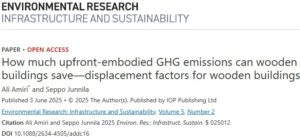
This study synthesized data from 92 case buildings across various geographies and typologies, offering one of the most comprehensive evaluations to date of how much greenhouse gas (GHG) emissions can be reduced by using wood instead of conventional materials like concrete, steel, or masonry.
By calculating displacement factors (DFs), a metric that quantifies avoided GHG emissions when wood replaces other materials, the study showed that, wooden buildings reduce upfront embodied GHG emissions on average by 23% compared to their non-wooden counterparts. However, results varied by building height, wood product type, and LCA method. Notably, low-rise buildings and those using minimally processed wood tended to perform best, while mid- and high-rise buildings often relied on hybrid structures with engineered wood (such as CLT), leading to more performance profiles.
The study also emphasized the need for clearer definitions around what qualifies as a “wooden building.” Many so-called timber buildings contain only a small percentage of wood in their structure or finishing layers, which can result in minimal emissions savings. As a result, we proposed a new classification framework for wooden and hybrid wooden buildings based on the proportion of wood used in both structural and non-structural components — a tool that could help improve transparency in future studies and policy work.
Academic and Professional Impact
Beyond the research itself, the visit helped broaden my professional network and opened new pathways for collaboration. I connected with researchers from several disciplines including forestry, architecture, and civil engineering, whose insights and ongoing work aligned closely with the goals of my project. These new contacts offer exciting potential for future joint initiatives.
In addition to research, I had the chance to participate in guest lecturing which was another meaningful aspect of the visit. Engaging with students and sharing knowledge about LCA, timber construction, and carbon strategies added valuable depth to my academic journey and strengthened my confidence in teaching in diverse contexts.
Personal Reflections and Inspirations
One of the most striking moments during the visit was seeing wooden university buildings on campus that combined timber structures with brick or hybrid facades. These buildings demonstrated that it is possible to maintain coherence in an area (E.g., university campus) while still using wood as the primary material. This example is particularly relevant for places like Aalto University campus, where concerns about visual alignment have previously limited timber construction. I hope to introduce these U.S. examples to inspire future campus development in Finland blending tradition with sustainability.
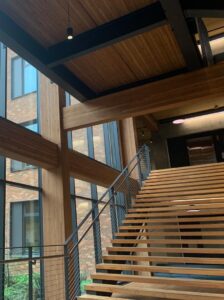
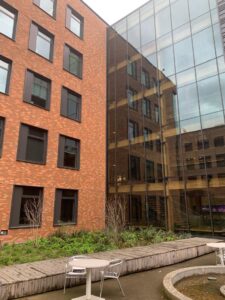
Figure. A university campus wooden building example with brick façade
Living and working in the U.S. also gave me a broader view of how academia can act as a bridge between disciplines and countries. I was reminded that real innovation happens when diverse teams collaborate, challenge assumptions, and build from each other’s strengths.
Looking Ahead – Research and Exchange
One of the most important takeaways from this visit is a clearer sense of where I can contribute next. In Finland, multi-story timber buildings are still relatively rare compared to single-family or low-rise wooden homes. This represents an exciting and much-needed focus area for future research, especially in the context of dense, urban development and climate targets.
At the same time, I see real value in strengthening two-way collaboration. As Finnish researchers, we can host colleagues from the U.S. and other countries, whether for short visits, joint projects, or longer research stays. I would be happy to welcome such exchanges in my group at Aalto University and continue building international bridges.
One of the interesting topics that emerged during discussions with U.S. researchers was the difference in forest harvesting efficiency between Finland and the U.S. Given Finland’s advanced harvesting practices and forest management strategies, there is clear potential for U.S.-based forest scientists and researchers to explore these systems more closely. Hosting research visits or academic exchanges in Finland would allow international scholars to learn from Nordic expertise and potentially adapt some of these high-efficiency, low-impact techniques to their local contexts. This could be a valuable step forward in improving wood use efficiency, reducing forest waste, and supporting more climate-responsible supply chains in North America.
Despite the challenging funding landscape in the U.S. during 2025, many of the discussions I had with researchers were focused on the future. Together with colleagues from forestry, architecture, and engineering, we began exploring opportunities for joint project development and co-funded research applications between Finland and the U.S. These conversations underscored the mutual interest in low-carbon construction and the value of combining expertise across regions. While the timing for launching new projects may not have been ideal this year, the foundations were laid for potential collaboration with the goal of aligning future proposals with European and U.S. climate research priorities.